Uncollectible Accounts Receivable Definition and Accounting
Thus, the bad debt expense is estimated indirectly as the change in the allowance. The allowance is a contra account and is credited instead of the Accounts Receivable control account because it is not known which individual accounts are uncollectible. Allowance for Doubtful Accounts decreases (debit) and AccountsReceivable for the specific customer also decreases (credit).Allowance for doubtful accounts decreases because the bad debtamount is no longer unclear. Accounts receivable decreases becausethere is an assumption that no debt will be collected on theidentified customer’s account. The understanding is that the couplewill make payments each month toward the principal borrowed, plusinterest. If the estimate of uncollectible accounts was too high, the company can reverse some of the allowance.
- In conclusion, accounting for uncollectible accounts involves estimating the amount of uncollectible accounts and creating an allowance for doubtful accounts.
- The Direct Write-Off Method is an alternative approach to accounting for uncollectible accounts, wherein bad debts are recognized only when they are deemed definitively uncollectible.
- These are typically accounts receivable that have been outstanding for an extended period, and after exhaustive efforts to collect, the company concludes that these debts will not be paid.
- Accounts receivable decreases because there is an assumption that no debt will be collected on the identified customer’s account.
What are the different types of uncollectible accounts expense?
Accounts receivable represent amounts due from customers as a result of credit sales. Unfortunately for various reasons, some accounts receivable will remain unpaid and will need to be provided for in the accounting records of the business. The aging of accounts receivable method involves categorizing accounts receivable by the length of time they have been outstanding and estimating the percentage of each category that will not be collected. If fewer accounts in dollars are written off than previously estimated, the Allowance account will have a credit balance prior to the adjustment. After analyzing the ending balance of $250,000 in Accounts Receivable, management estimated that $12,500 of these accounts would ultimately become uncollectible.
Bad Debt Expense Definition and Methods for Estimating
Each year, an estimation of uncollectible accounts must be made as a preliminary step in the preparation of financial statements. Some companies use the percentage of sales method, which calculates the expense to be recognized, an amount which is then added to the allowance for doubtful accounts. Other companies use the percentage of receivable method (or a variation known as the aging method). The reported expense is the amount needed to adjust the allowance to this ending total. Both methods provide no more than an approximation of net realizable value based on the validity of the percentages that are applied. A percentage of accounts receivable will become an uncollectible amount of cash for many reasons, requiring a periodic write-off of receivables at the end of the year.
Great! The Financial Professional Will Get Back To You Soon.
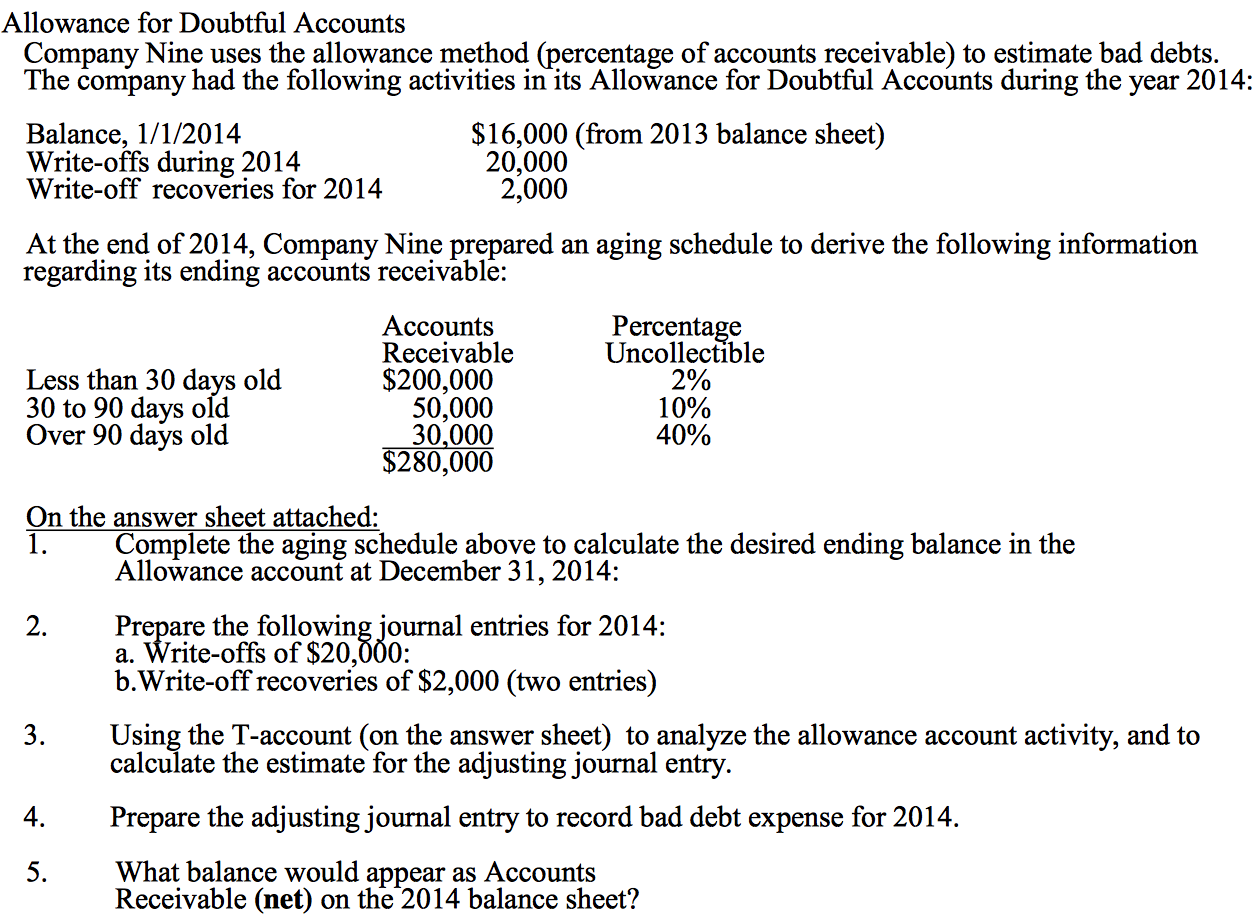
This method is usually superior as it takes into account factors such as past-due payments and the payment habits of customers. The aging method groups all outstanding accounts receivable by age, and specific percentages are applied to each group. For example, a company has $70,000 of accounts receivable less than 30 days outstanding and $30,000 of accounts receivable more than 30 days outstanding. The allowance for doubtful accounts, based on the percentage of sales, should be a credit balance of $20,760. Right now, it has a debit balance of $500 because last year we booked $7,500 but the actual write off was $8,000.
Percentage of Accounts Receivable Method Example
For example, based on experience, a company can expect only 1% of the accounts not yet due (sales made less than 30 days before the end of the accounting period) to be uncollectible. At the other extreme, a company can expect 50% of all accounts over 90 days past due to be uncollectible. For each age category, the firm multiplies the accounts receivable by the percentage estimated as uncollectible can i set up a payment plan for my taxes to find the estimated amount uncollectible. For example, assume Rankin’s allowance account had a $300 credit balance before adjustment. However, the balance sheet would show $100,000 accounts receivable less a $5,300 allowance for doubtful accounts, resulting in net receivables of $ 94,700. On the income statement, Bad Debt Expense would still be 1%of total net sales, or $5,000.
Step 2: Estimate the Amount of Uncollectible Accounts
Uncollectible accounts, commonly known as bad debts, refer to amounts that a business deems unlikely to be collected from its customers. These are typically accounts receivable that have been outstanding for an extended period, and after exhaustive efforts to collect, the company concludes that these debts will not be paid. Uncollectible accounts arise in the normal course of business and are an inherent risk of extending credit to customers. As shown in the T-accounts below, this entry successfully changes the allowance from a $3,000 debit balance to the desired $24,000 credit. Because bad debt expense had a zero balance prior to this entry, it is now based solely on the $27,000 amount needed to establish the proper allowance. When an account is determined to be uncollectible, the journal entry to write off the uncollectible account involves debiting the allowance for doubtful accounts account and crediting the accounts receivable account.
We would classify this expense as a selling expense since it is a normal consequence of selling on credit. Entries made under the allowance method after recording the annual adjusting entry are the same under either the direct or indirect approach to estimating the expense. This result is compared to the preadjustment balance in the allowance account, and the change is recorded in an adjusting entry.

Below are details regarding the amount of money of this expense and how it impacts the balance sheet, general ledger, and income statement. Estimating uncollectible accounts Accountants use two basic methods to estimate uncollectible accounts for a period. The first method—percentage-of-sales method—focuses on the income statement and the relationship of uncollectible accounts to sales.
Some of the people it owes money to will not be made whole, meaning those people must recognize a loss. This situation represents bad debt expense on the side that is not going to collect the funds they are owed. The outstanding balance of $2,000 that Craft did not repay will remain as bad debt. When a specific customer has been identified as an uncollectible account, the following journal entry would occur.
The balance sheet aging of receivables method is more complicated than the other two methods, but it tends to produce more accurate results. This is because it considers the amount of time that accounts receivable has been owed, and it assumes that the longer the time owed, the greater the possibility that individual accounts receivable will prove to be uncollectible. The income statement method (also known as the percentage of sales method) estimates bad debt expenses based on the assumption that at the end of the period, a certain percentage of sales during the period will not be collected. The estimation is typically based on credit sales only, not total sales (which include cash sales).